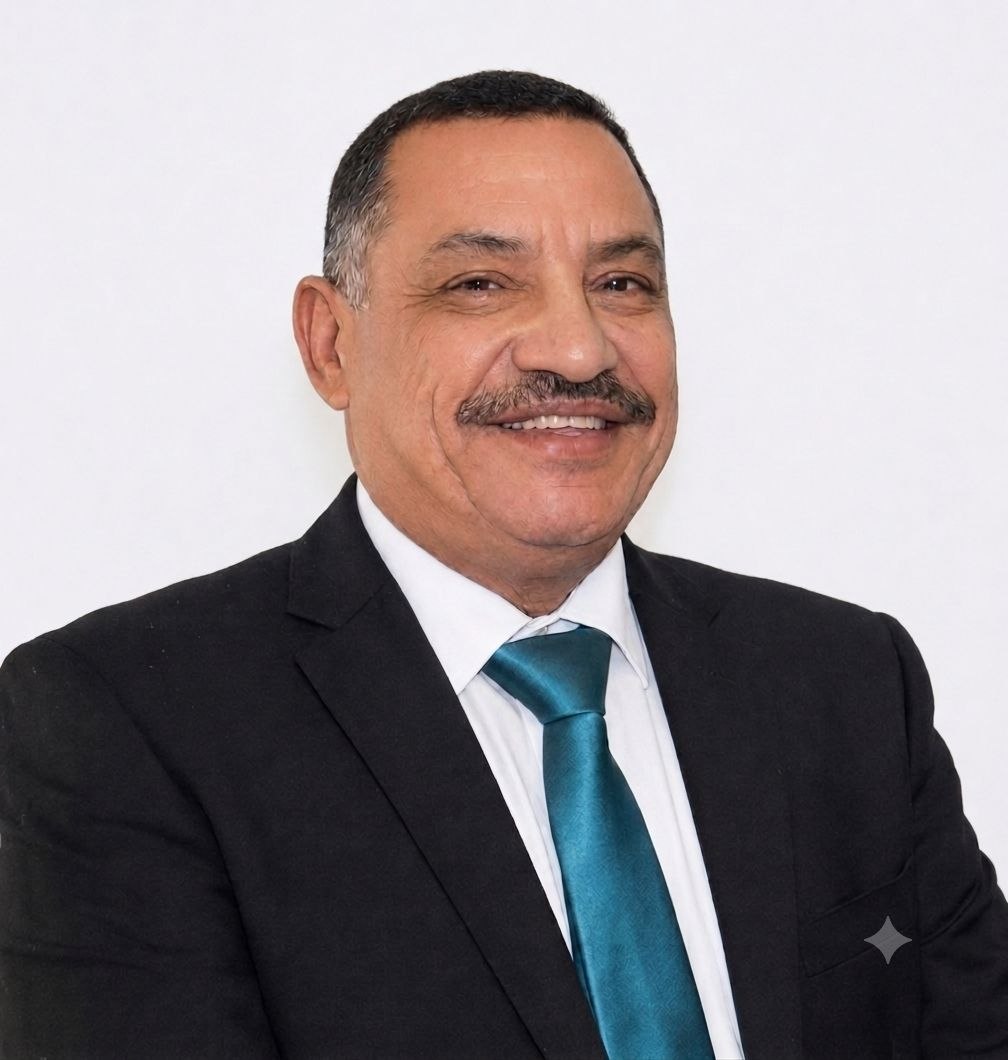
Professor of Corrosion Engineering at the Chemical Engineering Faculty, University of Technology, Iraq
Prof. Dr. Khalid Hamid Rashid Abdul-Khalik have many academic and research activities in the fields of chemical and corrosion engineering. The current research interests are corrosion and corrosion control, green corrosion inhibitors, green technologies, thermal engineering, and many other researches in the fields of chemical engineering. He have a B.Sc., M. Sc. and Ph.D. in chemical engineering from University of Baghdad and published more than 40 research papers in respected journals.
74
Scholar Pubs
37
Scopus Pubs
1,351
Scholar Citations
1,122
Scopus Citations
1,474
WoS Citations
29
h-index
| Certificate | University name | Country | Date of obtaining |
|---|---|---|---|
| Doctorate | University of Baghdad | Iraq | 2014-04-09 |
| The academic title | Date of obtaining |
|---|---|
| Professor | 2021-12-09 |
| Certificate | Date of obtaining | Description |
|---|---|---|
| Doctor of Philosophy | 2014-04-09 | Chemical Engineering / Corrosion Engineering |
| Name | Date | Description |
|---|---|---|
| Wasan Farhan Hameed | 2021 | Corrosion Inhibition of Mild Steel in CO2 Saturated Saline Solution Using Hexamethylenetetraamine |
| Ali Shareef Jasim | 2022 | Synthesis and Investigations of Organic Corrosion Inhibitors for Mild Steel in Hydrochloric acid Solution |
| Zinah Ibrahim Jasim | 2023 | Synthesis and Characterization of New Heterocyclic Compounds Containing Oxazolidine Ring as Corrosion Inhibitors for Mild Steel in Acidic Solution |
| Hussein Sami Hassan | 2024 | Synthesis and characterization of some new heterocyclic compounds |
| Wael Adel Mohammed | 2025 | Synthesis and Characterization of New Chalcones compounds as Corrosion Inhibitors for Mild steel in Acidic Solution |
| Qusay Ghanim Finish | 2027 | Mitigation of high-temperature corrosion of the fire side boiler tubes using thermal spray coating |
| Arkan Muwafaq Atiyah | 2026 | Synthesis, structural identifications of novel Schiff bases as corrosion inhibitors for mild steel in acidic solution |
| Name | Date | To Date |
|---|---|---|
| Professor of Corrosion Engineering at the Chemical Engineering Faculty, University of Technology, Iraq | 2021-12-09 | Present |
| Name | Description | Date |
|---|---|---|
| The international scientific award in gold medal | Awarded the international scientific Prize for the professors, academics and researchers (International Golden Medal with international scientific certificate) in the International Event in Iraq for the year 2019 was awarded by the EVEREST Organization Development Training/NGO and the French Society of thinkers, researchers and inventors in France at the headquarters of the European Union of scientists and inventors sponsored by the Society of Computer Science and Artificial Intelligence and Data Protection of the Ministry of Higher Education and Iraqi scientific research in 2019. | 2019-12-03 |
| Patent | Date | Description |
|---|---|---|
| Synthesis of a novel pyrazole heterocyclic derivative as corrosion inhibitor for low-carbon steel in 1M HCls | 2024-02-21 | A novel organic corrosion inhibitor, named 3, 5-dimethyl-1H-pyrazol-1-yl m (4-((4-hydroxybenzylidene) amino) phenyl) methanone (DPHM) has been effectively synthesized and characterized. The diagnosis of functional groups and constituents of DPHM has been conducted by FTIR, 1 H NMR, and 13C NMR. The inhibitor efficacy for low-carbon steel in 1 M HCl was evaluated by using weight loss and electrochemical techniques. The inhibition efficiency was increased with increasing the temperature and DPHM concentrations. The inhibition efficiency approaches a maximum value of 89.5% at 400 ppm of DPHM and 60 ◦C. The efficiency of the inhibitor was attributed to the formation of a protective mono-layer on the steel surface. The Langmuir adsorption isotherm was used to inspect the adsorption process mechanism. Theoretical quantum chemical simulations were used to investigate the mechanism of inhibition. The results revealed that the DPHM was the donor of electron, while the steel surface was an electron acceptor. Mathematical and statistical modelling were used as powerful tool for data representation. Exponential model, with 0.992 correlation coefficient, was the most accurate one. |
No publications available for this researcher
237
Reviews
41
Journals
Next Materials
Elsevier, Inc.
Clarivate PLC
International Journal of Electrochemical Science
Elsevier, Inc.
Results in Surfaces and Interfaces
Elsevier, Inc.
Journal of Molecular Liquids
Elsevier, Inc.
Surfaces and Interfaces
Elsevier, Inc.
Scientific Reports
Springer Nature
Results in Engineering
Elsevier, Inc.
Journal of Environmental Chemical Engineering
Clarivate PLC
Results in Chemistry
Elsevier, Inc.
Journal of Hazardous Materials Advances
Elsevier, Inc.
Microchemical Journal
Elsevier, Inc.
Next Research
Elsevier, Inc.
Journal of Bio- and Tribo-Corrosion
Springer Nature
Discover Chemistry
Clarivate PLC
Materialia
Elsevier, Inc.
Next Nanotechnology
Elsevier, Inc.
Chemical Papers
Clarivate PLC
Case Studies in Chemical and Environmental Engineering
Elsevier, Inc.
Materials Today Communications
Clarivate PLC
Hybrid Advances
Clarivate PLC
Chemical Thermodynamics and Thermal Analysis
Elsevier, Inc.
Discover Applied Sciences
Clarivate PLC
Electrochimica Acta
Elsevier, Inc.
Discover Electrochemistry
Clarivate PLC
Arabian Journal for Science and Engineering
Clarivate PLC
Progress in Engineering Science
Clarivate PLC
Fuel
Elsevier, Inc.
International Journal of Mathematics and Mathematical Sciences
Clarivate PLC
Next Chemical Engineering
Clarivate PLC
Chemosphere
Elsevier, Inc.
Silicon
Clarivate PLC
Journal of Industrial and Engineering Chemistry
Elsevier, Inc.
Diyala Journal of Engineering Sciences
Clarivate PLC
Sustainable Chemistry One World
Clarivate PLC
Bulletin of the National Research Centre
Clarivate PLC
Sustainable Chemistry and Pharmacy
Clarivate PLC
Adsorption
Clarivate PLC
Petroleum Science and Technology
Clarivate PLC
Defence Technology
Clarivate PLC
Al-Nahrain Journal for Engineering Sciences
Clarivate PLC
You must log in to be able to contact the researcher
Login